
Crawford County Arrests Today
Crawford County posts no page listing arrests from the past 24 or 48 hours. The Sheriff's Office and its Corrections/Jail page name the agency and the jail. Neither links to today's bookings. No roster, no booking-photo display, nothing to refresh. So there is no official entry order or daily cutoff to describe.
For a current custody question, the Crawford County Jail is the first call. Its published number is (989) 348-4822. The county lists it as staffed around the clock. The jail holds people arrested by agencies across Crawford County. That covers people who stay local. One central place to ask helps. But the jail does not keep every police report or later court file.
Check Crawford County's Last 24 Hours
With no public roster to refresh, work a narrow official sequence. Have the full name and a rough arrest time ready. A case number, booking number, agency, or location helps. It can separate people with similar names. Booking questions never belong on a 911 call.
- Call the Crawford County Jail at (989) 348-4822 for current county-jail custody.
- If the jail cannot confirm a completed intake, allow for processing and ask which agency holds the relevant record.
- For routine routing, call Crawford County Dispatch at (989) 348-6341, which operates around the clock.
- Use the county FOIA process for a specific booking record or photograph.
- Check the court record later for filed charges and the final disposition.
Custody and records drift apart fast. A released person leaves current custody, yet the booking record stays with the county. Someone sentenced to state prison moves into the Michigan Department of Corrections system. That system sits outside any county same-day view. A temporary ICE or MDOC hold can sit on the jail. That does not mean Crawford officers made the arrest.
Crawford Arrest Details to Request
The county publishes no standard booking screen with labeled fields. Treat the usual details as request targets instead. Name the specific item you want. Ask for the booking number, the charge, the arresting agency, or the date. A narrow ask beats requesting everything about a person. It usually cuts delay, search work, and cost.
| Record item | What to specify or verify |
|---|---|
| Name and identifier | Full name plus a booking, arrest, incident, or case number if known |
| Timing | Ask separately for arrest time and jail intake time |
| Agency | Identify the arresting agency and the jail that processed intake |
| Booked charge | Request the charge recorded at intake, then compare it with the court case |
| Bond and status | Confirm the amount or type with the court or jail and ask whether custody is current |
| Booking photograph | Ask whether an image exists, is releasable, or needs redaction |
Crawford County posts no web photo policy. A missing online image proves nothing. It may reflect nonpublication, a pending request, redaction, an exemption, or a record that simply does not exist. The official dispatched-agencies list shows why the agency field matters.
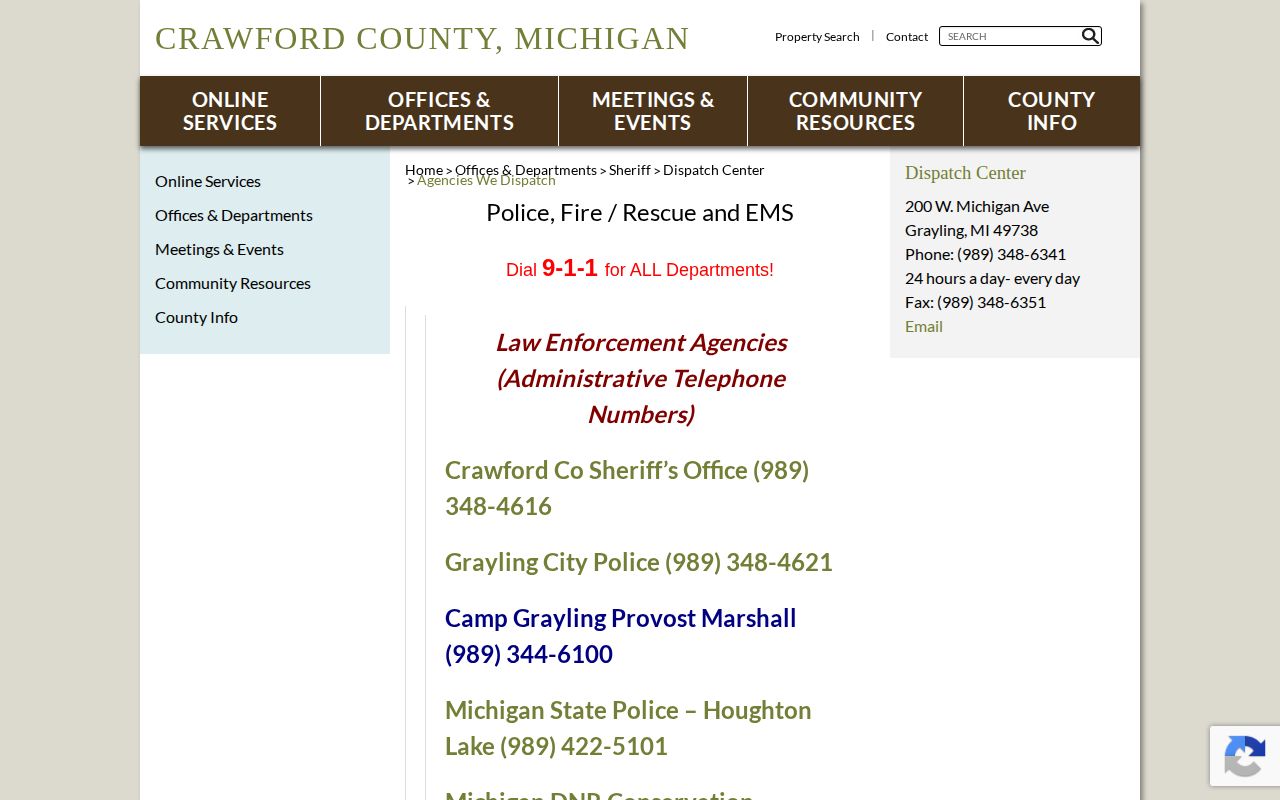
The sheriff's dispatched-agencies list helps route an incident question, though dispatch itself offers no public arrest feed.
Crawford's Missing Arrest Feed
The missing feed is the headline fact here. Crawford County gives residents a jail phone and a formal public-records route, nothing more. There is no live roster. No current booking list either. Treat third-party timestamps as worthless for posting time. An unofficial site can copy a stale entry, skip a release, mix up two people, or point at a different Crawford County entirely.
For a written record, the county FOIA page supplies the request form, public summary, policy, cost worksheet, and appeal materials. Michigan law generally requires a response within five business days. Extensions are allowed under the policy. Fees may cover search, review, separation, copying, and delivery. A tight date range and a named document speed everything up.
The MiCOURT Case Search helps once a case is filed, but it is not a live jail log and warns that online results are not the official court record.
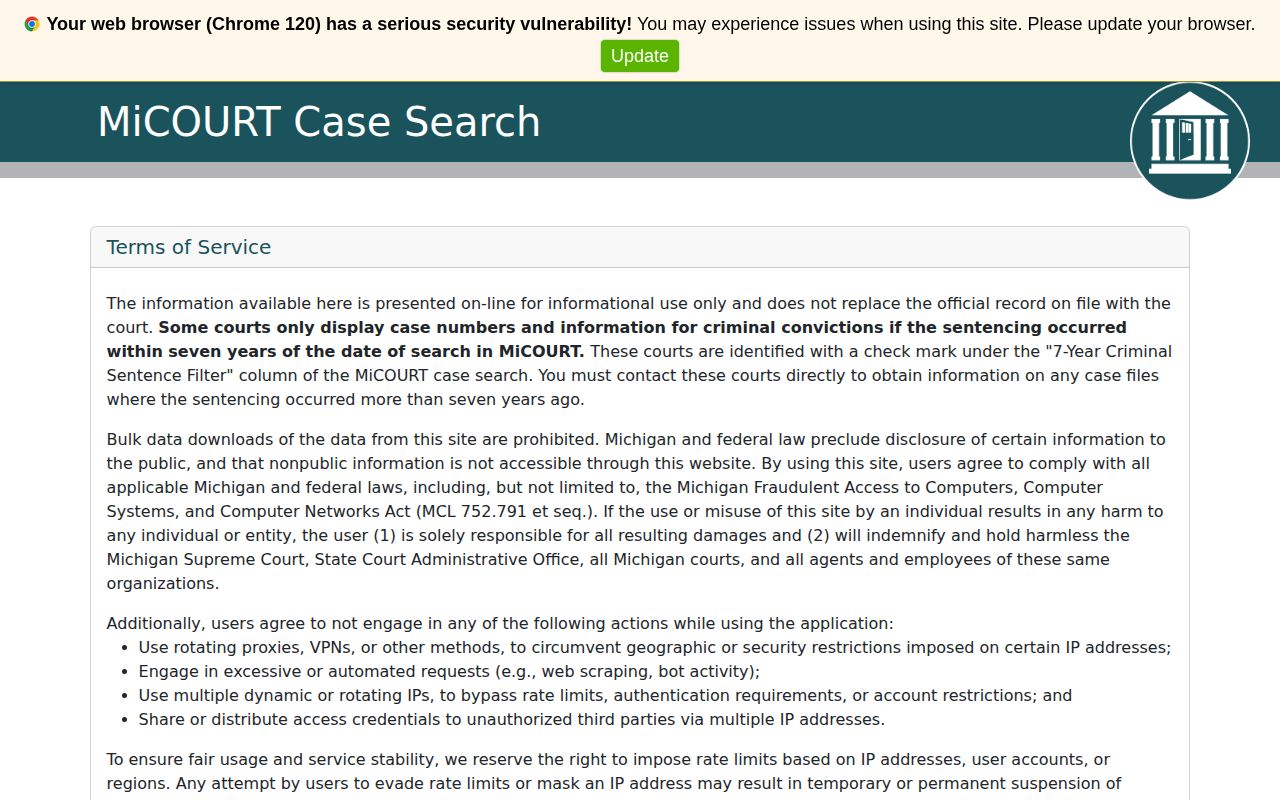
MiCOURT belongs later in the chain, once the question shifts from custody to court proceedings.
Crawford Arrest Timing and Guilt
A booking record is a point-in-time document. Charges filed at intake often change, get reduced, or drop away after arraignment. Crawford County's criminal-matters page walks through the local path. It covers arrest, arraignment, bond, and later hearings. The court clerk holds the authoritative case file.
Timing matters too. A same-day custody confirmation can arrive before prosecutors settle the filed charge. A court case can stay searchable long after release from the Crawford County Jail. Read the booking record and the court file as two documents made at two moments. The county criminal-matters page depicts that progression.
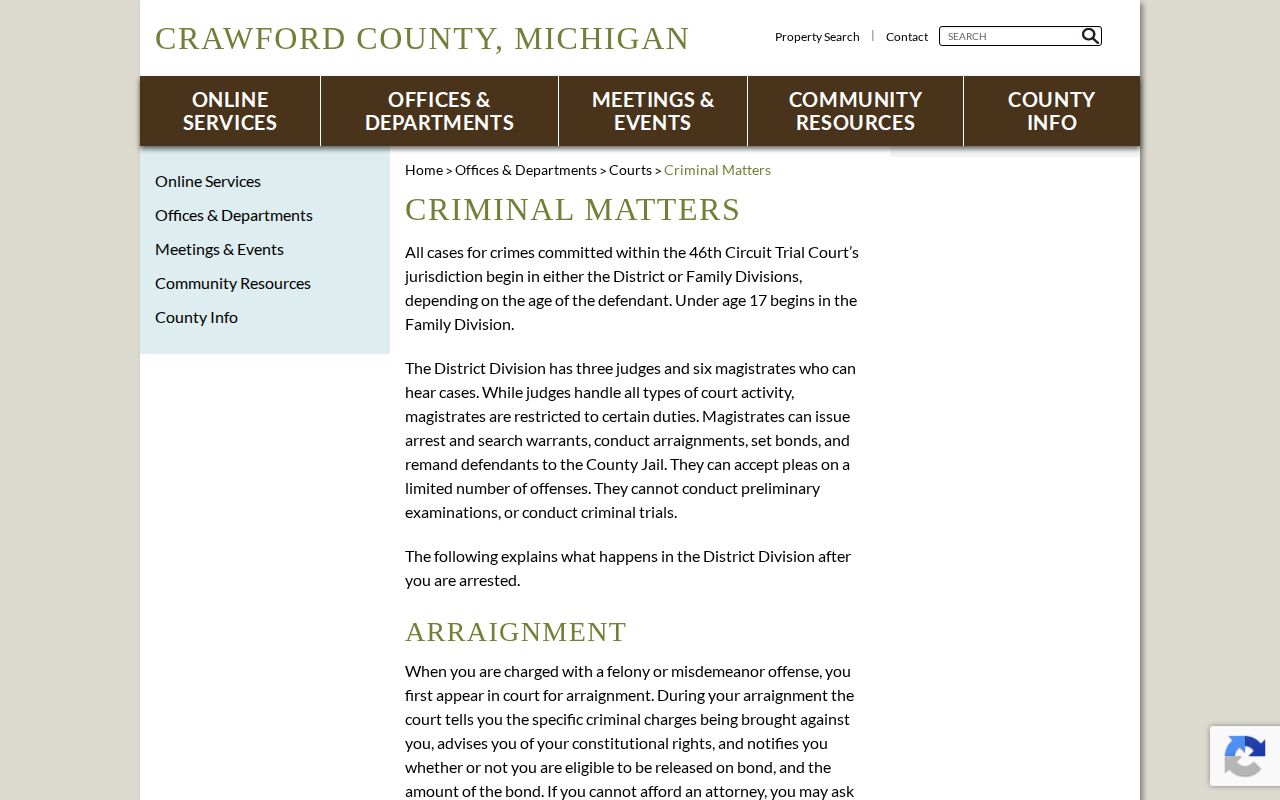
The official page, not a copied booking caption, is the sound source for what happens after intake.
Crawford Arrests Are Not in MSP Mobile
Michigan State Police runs an app called MSP Mobile. It carries state news, alerts, and tips. That is its whole job. The Crawford County Sheriff lists no booking app of its own, so a state tool will not answer a local custody question. The official MSP Mobile page describes exactly those community-alert and tip functions.
Alerts come before bookings, usually. Many Crawford arrests never trigger an alert at all. So the app cannot tell you a named person was booked at the jail. For a live answer, call the jail directly. MI-VONE... For a live answer, call the jail directly. MI-VINE is a separate state notification service worth trying for one person's status, though Crawford's jail page does not state its refresh schedule. If a search returns nothing, confirm with the jail itself.
Neither service offers a booking-photo gallery. Keep each source tied to the question it was built to answer.
Crawford Arrest Custody Boundaries
Not every custody question gets answered at the jail. A call to the Crawford County Jail only covers people held in that building. Its population includes pretrial detainees. Some inmates serve a year or less there. The jail also holds people for outside counties, ICE, or MDOC at times. So the agency running a case may sit far from the cell where the person actually sleeps. That gap trips up a lot of callers.
Custody stage matters just as much. State prison changes the answer. The Michigan Department of Corrections Offender Tracking Information System, known as OTIS, becomes the right tool there. OTIS leaves out county-jail detainees and anyone still unsentenced. Federal Bureau of Prisons and DHS immigration custody run on entirely separate systems. Pick the wrong system and a blank result tells you nothing about whether an arrest happened.
Two Crawford resources help sort this out. The VINELink Check covers release and transfer notifications, including the state service's local limits. For photos, records, and how county sources differ, the Crawford County recent arrests hub pulls it together.
Names alone are risky. Common Crawford surnames can match several people in custody at once. Give a birth date or agency identifier through the official channel. Do this only when the search actually needs it. Pin down the facility and the case first. An unofficial page with no clear Michigan jurisdiction should never settle the question.
A single arrest also spreads across several custodians. The arresting agency writes the incident report. The jail builds the intake and release file once the person arrives. A magistrate sets bond, and the court opens the case record. Ask one office for a document another keeps. You will likely hear "no record" while the paper still exists elsewhere.
Keep notes on whom you called, when, and what you asked for. Denials can be full or partial. If the county denies or partly denies a FOIA request, its official page supplies the written explanation and appeal materials. A denial of one document says nothing about custody or about what a different agency holds.
Custody shifts hour to hour. Bond gets posted. Conditions release a person. Arraignment happens, or a transfer moves someone to a new facility. Timing can affect a ride, a court date, a safety plan, or family contact. Then recheck with the responsible office directly. A copied booking photo or an old article proves nothing about where someone sits right now.
Public Record Search
Sponsored Results